Introduction
The submodeling technique allows you to follow up a simulation with a detailed study of one
or more local regions of interest, with the results from the original simulation providing
the boundary conditions at submodel "cuts." The original model is referred to as the
“global” model, and a subsequent detailed model is referred to as a “local” model or a
“submodel.” You identify the regions to investigate with submodeling during postprocessing
of the global model. 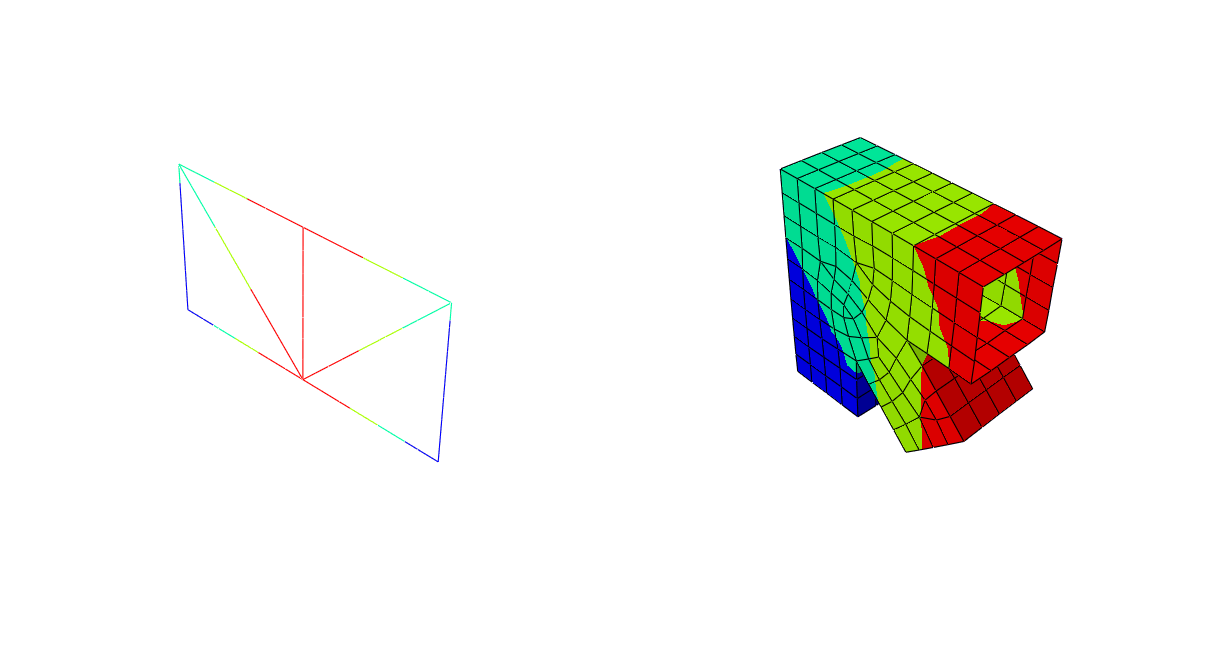
Submodeling is often significantly more efficient than using a globally refined model. The accuracy of submodel results relies on sufficient accuracy of the global results that drive results at the submodel boundary “cuts.” Submodeling leverages Saint-Venant’s principle that the difference between the effects of two different but statically equivalent loads becomes very small at sufficiently large distances from the loading. Judgment is required to position the submodel cuts far enough away from locations where you desire greater accuracy. It is good practice to confirm accuracy of the submodel results with refined global meshes for some representative cases. Occasionally, changes to modeling practices and accounting for more details within a localized region might influence a larger region than expected. Material properties are allowed to differ between the global model and the submodel; however, this might lead to inaccuracies if effects on solution variables extend to the submodel boundaries. For further discussion of submodeling accuracy, see Accuracy.