Failure measures are provided for use with linear elasticity as indicators of
material failure. They can be used to obtain postprocessed output requests based on the
evaluation of common failure theories for fiber-reinforced composite materials.
The orthotropic plane stress failure measures:
are indications of material failure (normally used for fiber-reinforced composite
materials; for alternative damage and failure models for fiber-reinforced composite
materials, see About Damage and Failure for Fiber-Reinforced Composites);
can be used only in conjunction with a linear elastic material model (with or without
local material orientations);
can be used for any element that uses a plane stress formulation; that is, for plane
stress continuum elements, shell elements, and membrane elements;
are postprocessed output requests and do not cause any material degradation; and
take values that are greater than or equal to 0.0, with values that are greater than or
equal to 1.0 implying failure.
Five different failure theories are provided: four stress-based theories and one
strain-based theory.
We denote orthotropic material directions by 1 and 2, with the 1-material direction aligned
with the fibers and the 2-material direction transverse to the fibers. For the failure
theories to work correctly, the 1- and 2-directions of the user-defined elastic material
constants must align with the fiber and the transverse-to-fiber directions, respectively.
For applications other than fiber-reinforced composites, the 1- and 2-material directions
should represent the strong and weak orthotropic-material directions, respectively.
In all cases tensile values must be positive and compressive values must be negative.
Stress-Based Failure Theories
The input data for the stress-based failure theories are tensile and compressive stress
limits, and , in the 1-direction; tensile and compressive stress limits, and , in the 2-direction; and shear strength (maximum shear stress),
S, in the X–Y plane.
All four stress-based theories are defined and available with a single definition in Abaqus; the desired output is chosen by the output variables described at the end of this
section.
Property module: material editor: MechanicalElasticityElastic: SuboptionsFail Stress
Maximum Stress Theory
If , ; otherwise, . If , ; otherwise, . The maximum stress failure criterion requires that
Tsai-Hill Theory
If , ; otherwise, . If , ; otherwise, . The Tsai-Hill failure criterion requires that
Tsai-Wu Theory
The Tsai-Wu failure criterion requires that
The Tsai-Wu coefficients are defined as follows:
is the equibiaxial stress at failure. If it is known, then
otherwise,
where . The default value of is zero. For the Tsai-Wu failure criterion either or must be given as input data. The coefficient is ignored if is given.
Azzi-Tsai-Hill Theory
The Azzi-Tsai-Hill failure theory is the same as the Tsai-Hill theory, except that the
absolute value of the cross product term is taken:
This difference between the two failure criteria shows up only when and have opposite signs.
Yamada-Sun Theory
If , ; otherwise, . The Yamada-Sun failure criterion requires that:
Stress-Based Failure Measures—Failure Envelopes
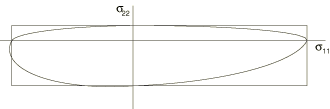
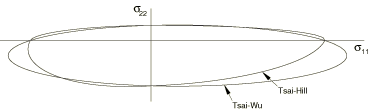
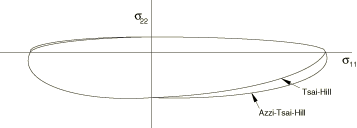
To illustrate the four stress-based failure measures, Figure 1, Figure 2, and Figure 3 show each failure envelope (i.e., ) in (–) stress space compared to the Tsai-Hill envelope for a given value of
in-plane shear stress. In each case the Tsai-Hill surface is the piecewise continuous
elliptical surface with each quadrant of the surface defined by an ellipse centered at the
origin. The parallelogram in Figure 1 defines the maximum stress surface. In Figure 2 the Tsai-Wu surface appears as the ellipse. In Figure 3 the Azzi-Tsai-Hill surface differs from the Tsai-Hill surface only in the second and
fourth quadrants, where it is the outside bounding surface (i.e., further from the origin).
Since all of the failure theories are calibrated by tensile and compressive failure under
uniaxial stress, they all give the same values on the stress axes.
Figure 1. Tsai-Hill versus maximum stress failure envelope (). Figure 2. Tsai-Hill versus Tsai-Wu failure envelope (, ). Figure 3. Tsai-Hill versus Azzi-Tsai-Hill failure envelope ().
Strain-Based Failure Theory
The input data for the strain-based theory are tensile and compressive strain limits, and , in the 1-direction; tensile and compressive strain limits, and , in the 2-direction; and shear strain limit, , in the X–Y plane.
Property module: material editor: MechanicalElasticityElastic: SuboptionsFail Strain
Maximum Strain Theory
If , ; otherwise, . If , ; otherwise, . The maximum strain failure criterion requires that
Elements
The plane stress orthotropic failure measures can be used with any plane stress, shell, or
membrane element in Abaqus.
Output
Abaqus provides output of the failure index, R, if failure measures are
defined with the material description. The definition of the failure index and the different
output variables are described below.
Output Failure Indices
Each of the stress-based failure theories defines a failure surface surrounding the
origin in the three-dimensional space . Failure occurs any time a state of stress is either on or outside this
surface. The failure index, R, is used to measure the proximity to
the failure surface. R is defined as the scaling factor such that,
for the given stress state ,
that is, is the scaling factor with which we need to multiply all of the stress
components simultaneously to lie on the failure surface. Values indicate that the state of stress is within the failure surface, while
values indicate failure. For the maximum stress theory .
The failure index R is defined similarly for the maximum strain
failure theory. R is the scaling factor such that, for the given
strain state ,
For the maximum strain theory .
Output Variables
Output variable CFAILURE will provide
output for all of the stress- and strain-based failure theories (see Abaqus/Standard Output Variable Identifiers and Abaqus/Explicit Output Variable Identifiers), with the
exception of the Yamada-Sun failure theory. In Abaqus/Standard history output can also be requested for the individual stress theories with output
variables MSTRS,
TSAIH,
TSAIW,
YAMADASUN, and
AZZIT and for the strain theory with
output variable MSTRN.
Output variables for the stress- and strain-based failure theories are always calculated
at the material points of the element. In Abaqus/Standard element output can be requested at a location other than the material points (see Output to the Data and Results Files); in this case
the output variables are first calculated at the material points, then interpolated to the
element centroid or extrapolated to the nodes.