Design Response and Flow Path | ||
| ||
A design response is a quantity that is derived from the CFD model and is a measure for the CFD model's behavior. Hence, this quantity is called a "response". The topology optimization approach in SIMULIA Tosca Fluid implements a backflow prevention strategy. As a consequence it needs information about the backflow in the CFD model. The design response used in for the objective function therefore contains information about the backflow and hence the type of the design response is called BACKFLOW.
A design response is defined using the <DRESP> command:
<DRESP><ID_NAME>MyDesignResponse</ID_NAME><INFLOW>MyInflow</INFLOW><OUTFLOW>MyOutflow</OUTFLOW><TYPE>BACKFLOW</TYPE></DRESP>
The backflow design response associated with a flow path. A flow path is a logic entity that represents a unique combination of two face groups - an inflow and an outflow. It represents a "path" through the fluid mesh along which backflow can be minimized. The following figure illustrates this:
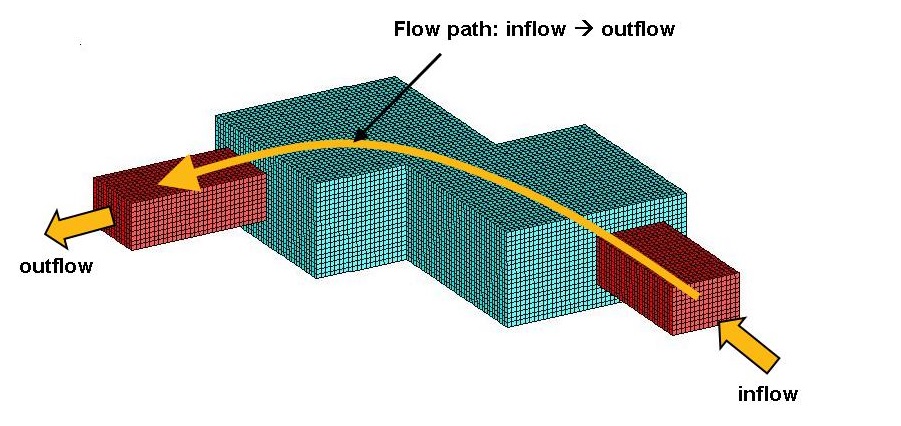
The flow paths are defined using the <FLOW_PATHS> command:
<FLOW_PATHS><ID_NAME>MyFlowPaths</ID_NAME><PATH>MyInflow, MyOutflow</PATH></FLOW_PATHS>
Here, one flow path is defined referencing an inflow and an outflow cellface group. Multiple <PATH> commands can be used to define multiple flowpaths in the same <FLOW_PATHS> command block. A single cellface group can also be referenced in different <PATH> commands. For example, consider a model with one inlet and two outlets where backflow along both paths is to be minimized. In this case, one would define two flow paths, both referencing the same inflow flow boundary:
<FLOW_PATHS><ID_NAME>MyFlowPaths</ID_NAME><PATH>MyInflow_1, MyOutflow_1</PATH><PATH>MyInflow_1, MyOutflow_2</PATH></FLOW_PATHS>