-
Define input data and Design Variables.
FEM_INPUT
  ID_NAME  = MY_INPUT_FILES
  FILE     = control_arm.inp
END_

DV_TOPO
  ID_NAME  = DESIGN_AREA
  EL_GROUP = DESIGN_ELEMENTS
END_
-
Create a constraint for the volume.
-
Define a Design Response (DRESP) with the volume:
DRESP
  ID_NAME    = TOSCA_DRESP_2_VOLUME_CONSTRAINT_1
  LIST       = LIST
  DEF_TYPE   = SYSTEM
  EL_GROUP   = ALL_ELEMENTS
  TYPE       = VOLUME
  UPDATE     = EVER
  GROUP_OPER = Sum
END_
-
Reference the Design Response in a constraint (CONSTRAINT) and constrain it to 70% of the initial volume:
CONSTRAINT
  ID_NAME   = CONSTRAINT_1_VOLUME_CONSTRAINT_1
  DRESP     = TOSCA_DRESP_2_VOLUME_CONSTRAINT_1
  MAGNITUDE = REL
  EQ_VALUE  = 0.7
END_
-
To define the Objective Function (OBJ_FUNC) for the compliance (STRAIN_ENERGY), do the following:
-
Create a Design Response (DRESP):
DRESP
  ID_NAME    = TOSCA_DRESP_1_COMPLIANCE_TERM_1
  LIST       = LIST
  DEF_TYPE   = SYSTEM
  EL_GROUP   = ALL_ELEMENTS
  TYPE       = STRAIN_ENERGY
  UPDATE     = EVER
  GROUP_OPER = Sum
END_
-
Reference the Design Response in the Objective Function (OBJ_FUNC) and minimize it:
OBJ_FUNC
  ID_NAME = OBJ_FUNC_1_OBJ_FUNC_ITEM_1
  TARGET  = MIN
  DRESP   = TOSCA_DRESP_1_COMPLIANCE_TERM_1
END_
-
Define the DVCON_TOPO for the demold restriction.
DVCON_TOPO
  ID_NAME           = DVCON_TOPO_1_DEMOLD_CONTROL_1
  EL_GROUP          = DESIGN_ELEMENTS
  CHECK_TYPE        = CAST
  PULL_DIR          = 0.,0.,1.
  CHECK_GROUP       = ALL_ELEMENTS
  MID_PLANE         = NONE
  PULL_CS           = CS_0
  CREATE_PULL_GROUP = NO
END_
-
Reference the Design Variables, Objective Function and Constraints as well as DVCON in the OPTIMIZE command:
OPTIMIZE
  ID_NAME    = OPTIMIZE_1_TOPOLOGY_OPTIMIZATION_SENSITIVITY
  DV         = DESIGN_AREA
  OBJ_FUNC   = OBJ_FUNC_1_OBJ_FUNC_ITEM_1
  DVCON      = DVCON_TOPO_1_DEMOLD_CONTROL_1
  CONSTRAINT = CONSTRAINT_1_VOLUME_CONSTRAINT_1
  STRATEGY   = TOPO_CONTROLLER
END_
-
Define the smooth command.
SMOOTH
  ID_NAME                 = ISO_SMOOTHING_0_3
  TASK                    = iso
  ISO_VALUE               = 0.3
  SELF_INTERSECTION_CHECK = runtime
  SMOOTH_CYCLES           = 10
  REDUCTION_RATE          = 60
  REDUCTION_ANGEL         = 5.0
  FORMAT                  = vtf
  FORMAT                  = stl
  FORMAT                  = onf
END_
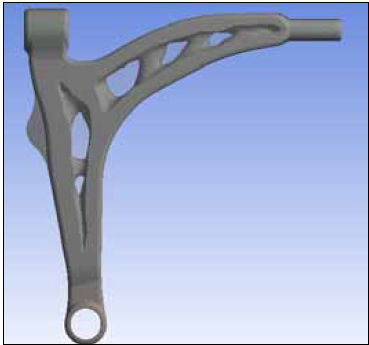
The optimization result looks as follows: